

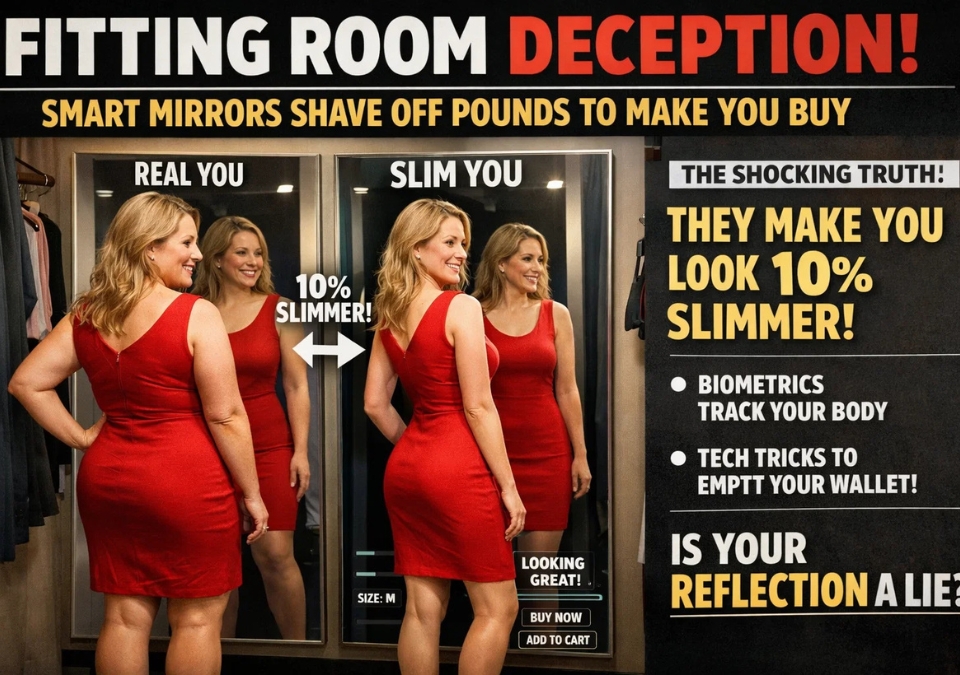
The Myth: The fitting room mirror is just a piece of silvered glass. It reflects reality. If you look thin and glowing, the dress fits. It’s a fair trade between your eyes and your body.
The Reality: In 2026, the fitting room mirror is a high-tech dopamine dealer. It slims you down by 10%, elongates your legs, and retouches your skin in real-time. You aren’t buying a garment; you’re buying the «upgraded version of yourself» that an algorithm just shoved down your throat.
THE ANATOMY OF THE LIE: HOW THEY SLIM YOU WITHOUT A DIET
Retailers realized long ago: if a woman likes what she sees, she buys 3x more. Now, they’ve started «overclocking» reality.
- Optical Distortion. Even standard «analog» mirrors in mass-market stores often feature a subtle vertical curve. This stretches your silhouette by 5–10%. You look taller and leaner. The effect vanishes the moment you get the item home and look into your honest IKEA mirror.
- Lighting Terrorism. Fitting rooms use «complimentary lighting.» Lamps with specific Color Rendering Indices (CRI) hide cellulite, under-eye bags, and skin imperfections. This is light that «forgives» your flaws, unlike the ruthless sun on the street.
- Digital Slimming. In 2026, mirrors are screens. they use Real-Time Body Reshaping AI analyzes your silhouette and, in milliseconds, renders an image where the waist is narrower and the shoulders are straighter. It’s a digital corset you can’t feel, but can’t stop looking at.
WALLET BIOMETRICS: WHEN THE GLASS KNOWS YOU CRACKED
In top-tier U.S. boutiques, mirrors are equipped with hidden cameras and emotion-recognition systems (like Affectiva). Here is how they manage your cash:
- The Doubt Detector. If the system sees you frowning or turning for too long, the mirror subtly shifts the color grade to a warmer tone to make your face look fresher and more rested.
- The Approval Trigger. The moment the sensors detect a «micro-smile» (the second you start liking yourself), the mirror flashes a notification: «Only 2 left in your size.» It strikes at the exact peak of your dopamine spike.
- Gaze Analysis. The mirror tracks which part of your body you’re looking at with dissatisfaction and «highlights» an accessory on a nearby shelf designed to «fix» it. This is marketing injected directly into your brain.
The Verdict: Your reflection in a store is a custom-made commercial produced specifically for you. Don’t trust the glass that’s trying to please you. Trust the measuring tape and the feel of the fabric.

