Sometimes your job as a writer is simple to state, but hard to do:
Explain something complex to someone who doesn’t know the basics.
Say you’re trying to explain what a cloud-based CRM is.
Your reader might not understand:
- what “CRM” means
- what “cloud” means
- or even how SaaS works at all
If you start from a formal definition, you’ll lose them by the second paragraph.
Let’s break down how to do it better.
Why Most Explanations Fail
The most common mistake?
Starting with the term.
“CRM stands for Customer Relationship Management. It’s a cloud-based system for managing the full sales lifecycle…”
Technically correct.
Practically useless.
If the reader doesn’t understand the words, they won’t grasp the meaning.
Where You Should Actually Start
Not with a definition.
But with a question:
What does the reader already know?
They may not know what CRM is.
But they probably understand:
- what a customer database is
- the difference between a program and a website
- how using email and spreadsheets becomes messy over time
That’s where you start — with familiar ground.
Explain the New Through the Familiar
If someone uses spreadsheets to track customers,
show how CRM is different from a spreadsheet.
If they know what a website is,
explain how a cloud service is just software in a browser.
Don’t widen the conceptual gap.
Narrow it to what’s already familiar.
Example: How to Explain CRM Clearly
❌ Not this:
“CRM is a system for automating sales workflows.”
✅ Try this:
“CRM is like a customer database — but instead of a spreadsheet, it’s a digital file cabinet.
With cards for each customer, notes, call logs, meeting history, and sales reports — all in one place.”
Now the reader has a picture.
Now you can move forward.
When in Doubt, Go Back to Basics
Don’t be afraid of stating the obvious.
When you have just a few clients, you can remember everything — names, questions, deals — in your head.
When the number grows, you start writing things down.
When more people get involved, you have to share what’s written.
That’s when emails, spreadsheets, and group chats begin to fail.
If your reader nods along, you’re doing it right.
Where CRM — and “The Cloud” — Actually Come In
When teams grow and customer data spreads across tools, chaos sets in.
So companies created digital “file cabinets” — where sales reps log client info into a shared system.
The first CRMs:
- were expensive
- required office servers
- only worked on in-house machines
Cloud-based CRM changed that.
What “Cloud-Based” Actually Means
A cloud CRM is just a shared client database that:
- lives on the internet
- is password-protected
- runs in a browser
Which means:
- A sales rep can access it from a café
- A manager can check reports while traveling
- The team doesn’t need to be in the same room
No magic. Just access — anywhere.
Analogies Work Better Than Definitions
When in doubt, compare it to something they already use.
“Have you used Google Docs?
It’s a word processor — but online, not installed.”
Same with cloud CRMs: it’s like a shared spreadsheet — but smarter.
Or:
“You’ve checked email from different devices, right?
Cloud CRM is the same — except instead of emails, you see customers and deals.”
You’re not asking them to believe you.
You’re helping them recognize something they’ve already experienced.
It’s Better to Over-Explain Than Under-Explain
If you’re unsure what the reader knows — assume the worst.
When you explain something basic, the reader thinks:
“Yep, I already know that.”
No harm done.
But if you skip something they don’t know?
They’ll get confused, frustrated, or stop reading altogether.
Why Textbooks Often Fail
Imagine reading this:
“To administer the fief efficiently, the lord delegated land to vassals…”
If you don’t know what a fief or a vassal is —
this sentence is just noise.
That’s what happens with business content too — when you start from the middle.
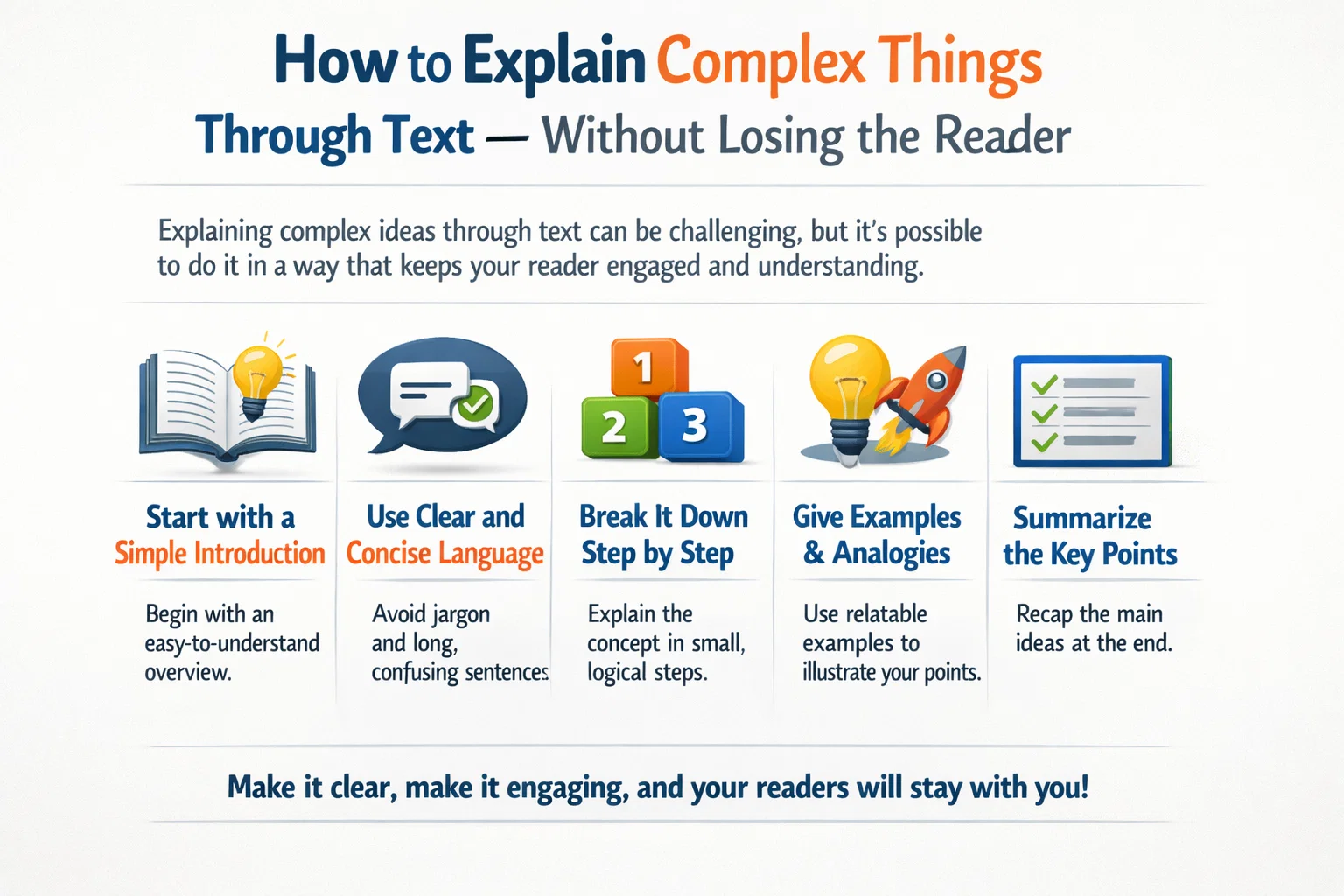
Final Principles
When explaining complex things:
✅ Go from familiar → unfamiliar
✅ Go from simple → complex
✅ Go from concrete → abstract
Don’t start with terms.
Start with experiences.
Bottom Line
A good explanation isn’t when someone memorizes your definition.
It’s when they say:
“Oh. Now I get it.”